The Trill of Squill

April in Minnesota might be one of the toughest months. It teases us. Last week we felt hints of warmth, just enough to make it feel like we were turning a corner. And then today it was back to 19 degrees. The landscape is still largely gray and brown, caught between seasons, not quite ready to let go of winter.
And yet, this is the time when the first signs begin to appear. Not the season itself, just hints of sight and sound.
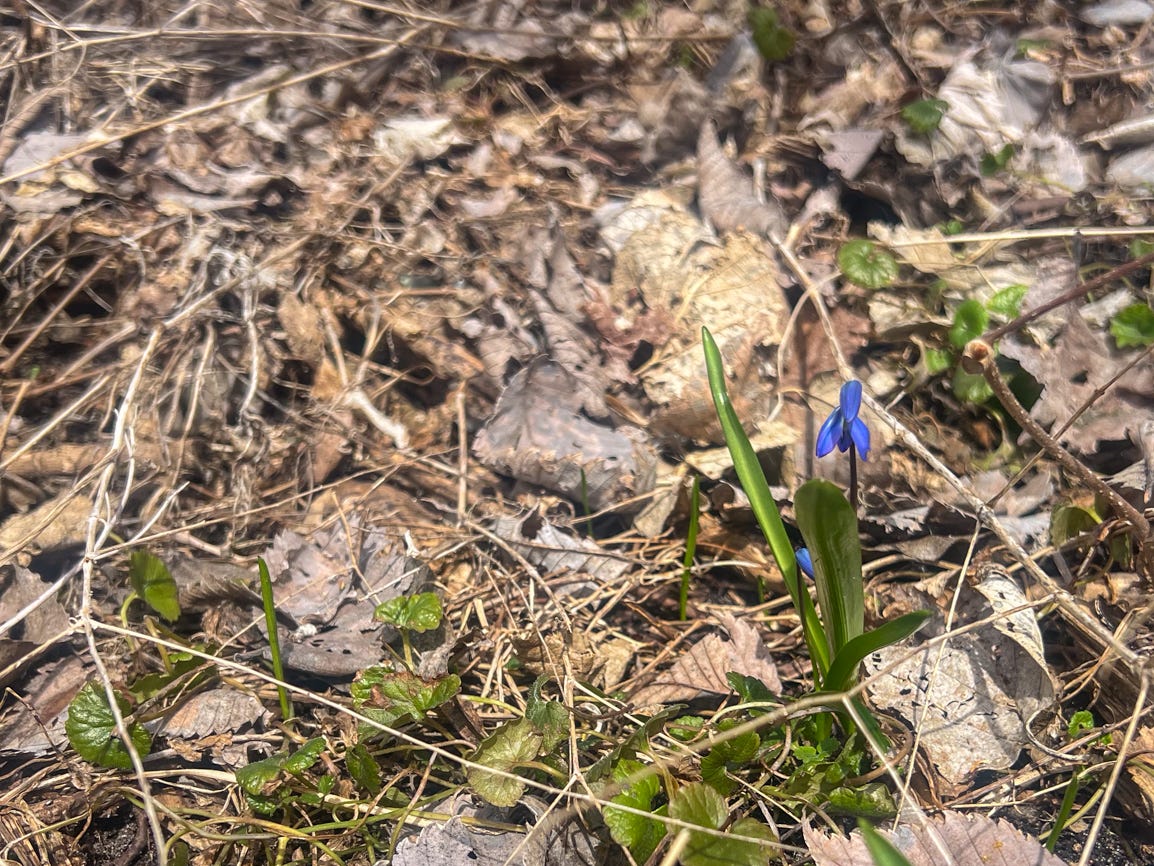
This afternoon, walking through The Conservancy on the northeast side of Cedar Lake, I came across the first real color I have seen this year. A small patch of blue. It popped. It stopped me more than I expected, and I had to take a picture. And then I realized it was Siberian squill.
And then, almost immediately, another thought followed. This is not what we are trying to grow here.
Siberian squill is one of those early bloomers that shows up before most other plants have even emerged. It takes advantage of this brief window before the tree canopy fills in, when sunlight still reaches the forest floor. It is easy to see why it spreads. It feels like spring. But it is not native to these woodlands, and if left alone, it can crowd out the species that belong here, the ones that are part of a healthy woodland ecosystem. So I found myself reacting: The color, welcome. The plant, not so much.
I’m still learning how to read the woods, and I’ve been hearing more and more from friends about “ephemerals.” I found myself asking, is this one? As it turns out, the word ephemeral simply means short-lived, something that appears briefly and then disappears. In ecology, spring ephemerals are those early woodland plants that emerge before the canopy closes, bloom quickly, and then retreat underground for the rest of the year. They are easy to miss, but they are also some of the most telling plants in a woodland. Not because they last, but because of what they indicate.
The native ephemerals we hope to see here, trillium, bloodroot, Dutchman’s breeches, spring beauty, are not just beautiful. They are evidence. They tell us that light is reaching the ground in the right way, that soils are intact, that the relationships beneath the surface are functioning well enough to support them. In that sense, they are small, passing signs of a deeper health that we cannot otherwise see.
As I kept walking, it was hard not to sit with the fact that we do not yet have enough of that, at least not consistently. There are places where the system is still too closed off, too dominated by invasive growth, for those native ephemerals to return in any meaningful way. It made that first flash of color feel a little deceptive, at least if I had not paused long enough to ask what it really meant.
It would be easy to read the squill as reassurance. Spring is coming. Nature is doing its work. Everything will take care of itself. But that is not what I’m seeing in these woods.
What I see instead is potential. And the reminder that potential does not fulfill itself.
These woodlands do not return to health simply because the seasons turn. They recover because people show up and do the work. Because buckthorn is cut back. Because overgrowth is cleared. Because light is allowed to reach the forest floor again. Because soils are protected and space is made for native plants to return. Without that, the system does not reset. It continues on the path it is already on.
And so those early signs begin to take on a different meaning. They are not the outcome. They are not even the beginning. They are more like an opening, a brief glimpse of what could be there under the right conditions.
By the time I made my way out of The Conservancy, I found myself looking differently at everything around me. I was reminded and encouraged that the gray and brown are not empty. It felt like a place with something just beneath the surface. Not visible yet, but possible.
Maybe that is what April in Minnesota is really about. Not comfort, but a reminder. Renewal does not happen passively. It is within reach, but it requires action. What we are seeing now, these small, fleeting signs, are not the season itself, but signals of what might come if we are willing to do what is required to bring it forward. (Or we could continue to ignore it and allow the invasives to progress in destroying and eliminating our ecological systems.)
Even in the cold of today, I found myself thinking, hope springs eternal. But for now, it shows itself only in brief, ephemeral ways.